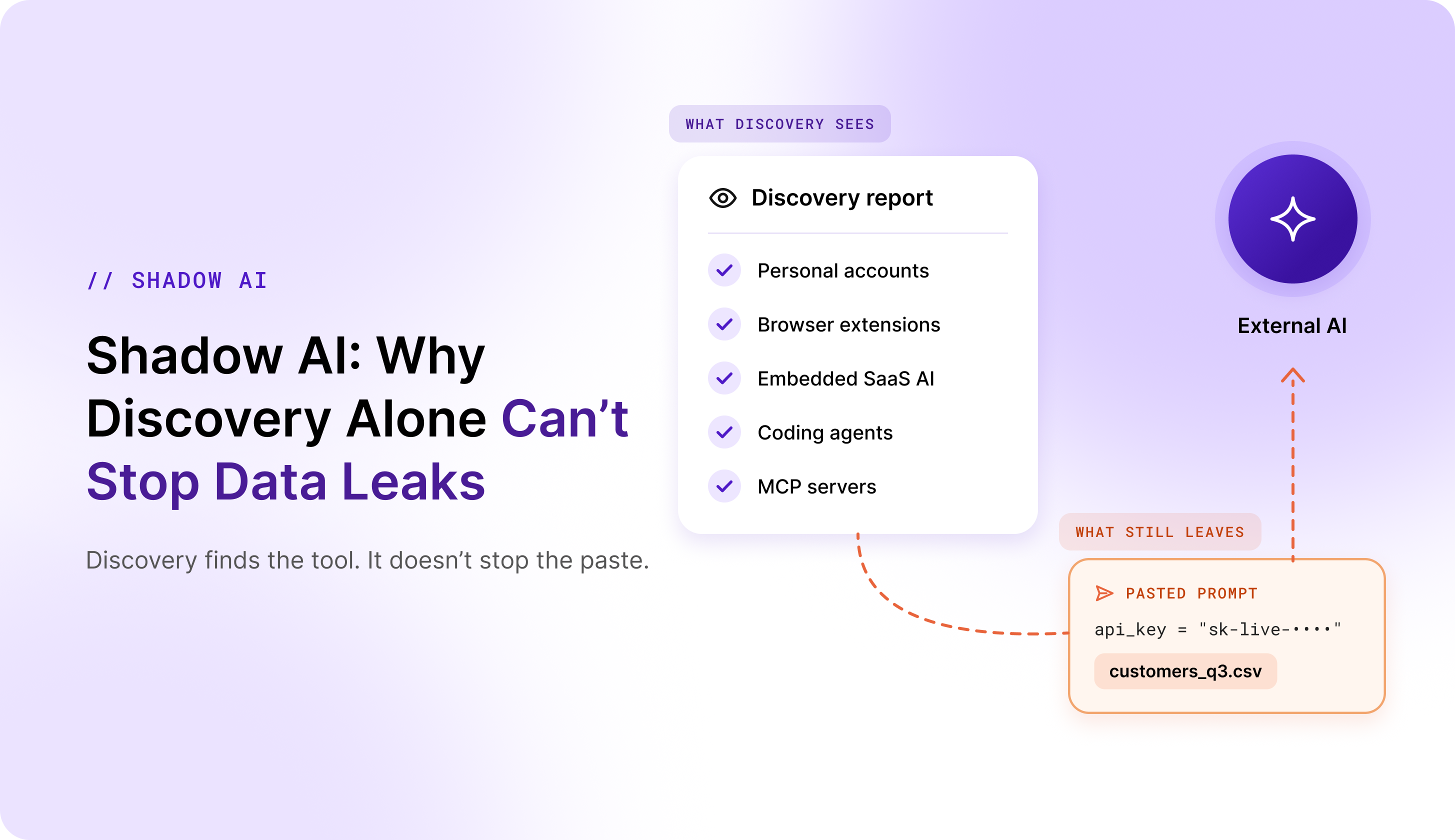

Discovery tells you an employee used an AI tool. It does not stop the next paste.
Shadow AI is the use of AI tools, accounts, and agents that security has not approved. Most programs start by finding it, which is the right first move. But a report that lists the tools in use cannot decide what each one may receive, and it cannot recall a prompt that has already been sent.
The problem is about to widen. Forrester's 2027 predictions say one in three large Asia Pacific enterprises will find at least 10 employee-built shadow AI agents for every officially sanctioned one. Today, IBM's 2026 Cost of a Data Breach Report already puts shadow AI in 43% of security incidents, up from 20% a year earlier. Cisco Talos, in its October guidance on shadow AI, says it plainly: "Visibility comes first." That is right, and it is also where many programs stop.
This guide covers what shadow AI is, where it hides, how the risk is expected to change in 2027, and why control has to sit in the path of each request. For the wider risk map, start with our guide to AI security risks for enterprises.
What Is Shadow AI?
Shadow AI is the use of AI tools, accounts, and agents that employees adopt without security approval. It covers anything that sends company data to an AI model, or lets an AI act on company systems, outside the controls security has set.
Shadow AI shows up in three forms:
- Standalone tools and personal accounts. Employees use consumer chatbots and AI apps outside any company agreement.
- AI inside approved software. Vendors add AI features to platforms that passed security review before those features existed, as the Cloud Security Alliance notes in its shadow AI research.
- Agents and connections. Coding agents, MCP servers, agent skills, and workflows that act on company systems without being registered anywhere.
Most shadow AI starts as an employee trying to finish work faster, not as an attack. That is why it spreads quietly.
What are the 5 Real Examples of Shadow AI in the Workplace?
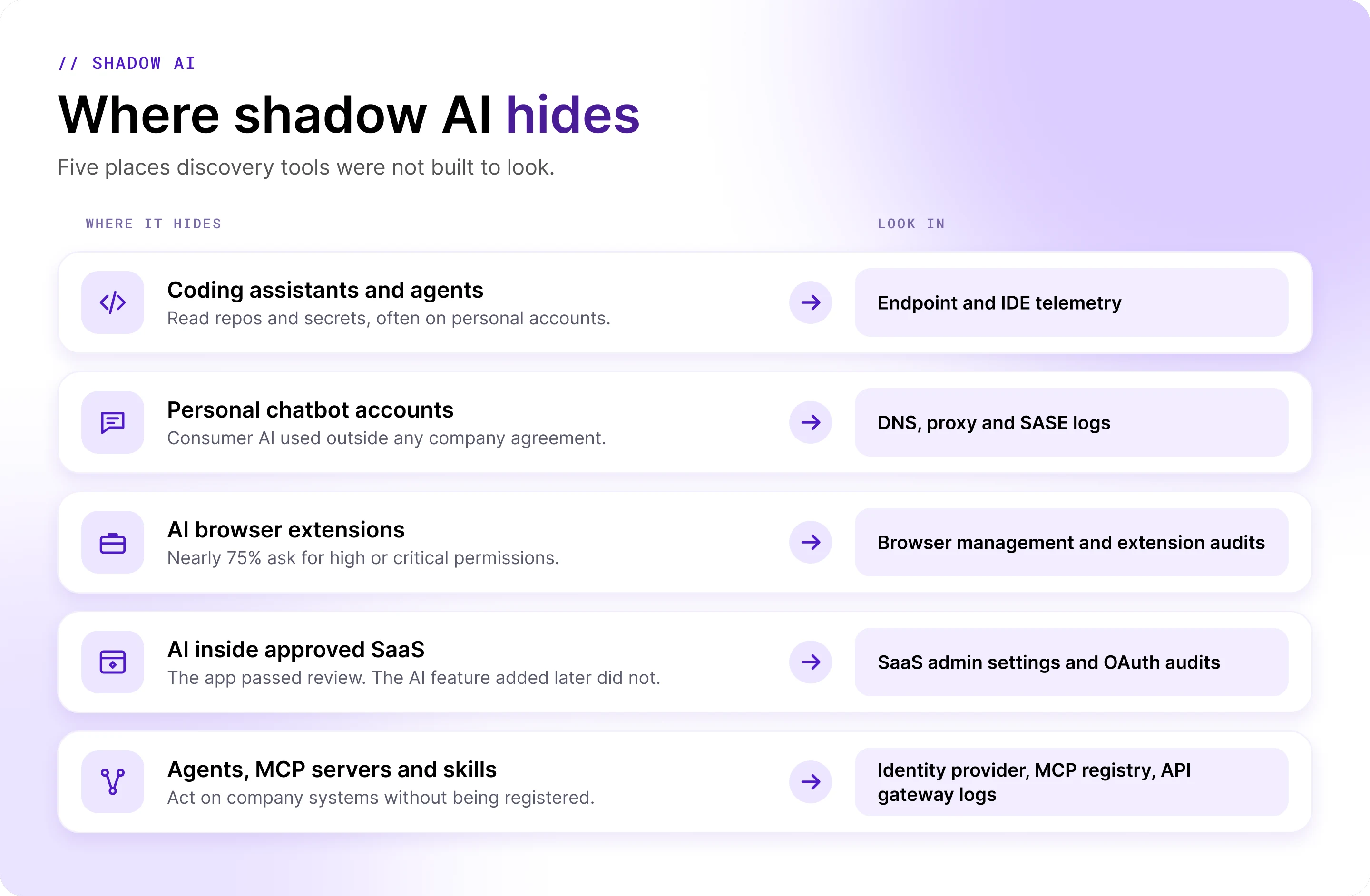
Shadow AI shows up in developer tools, personal chatbot accounts, browser extensions, AI features inside approved software, and agents nobody registered. Cisco Talos groups it into seven kinds: personal accounts, unapproved browser extensions, embedded SaaS AI, internal models, agents, model gateways, and integrations such as MCP servers.
Five examples cover most of what security teams find:
- Coding assistants and agents on personal accounts. In April 2023, Samsung engineers uploaded internal source code to ChatGPT, and the company banned generative AI on company devices, Bloomberg reported. Coding agents raise the stakes because they also read repositories and secrets. See how DAXA approaches AI coding assistants.
- Personal chatbot accounts. Netskope's 2026 report, cited by Cisco Talos, found 47% of generative AI users still used personal AI applications. Akamai and LayerX found 14.4% of conversations using corporate email addresses ran on personal freemium subscriptions.
- AI browser extensions. The same Akamai report found nearly 75% of AI browser extensions request high or critical permissions, and 16.31% have known CVEs, against 10.8% of all extensions.
- AI features inside approved SaaS. The platform passed review. The AI feature added later did not.
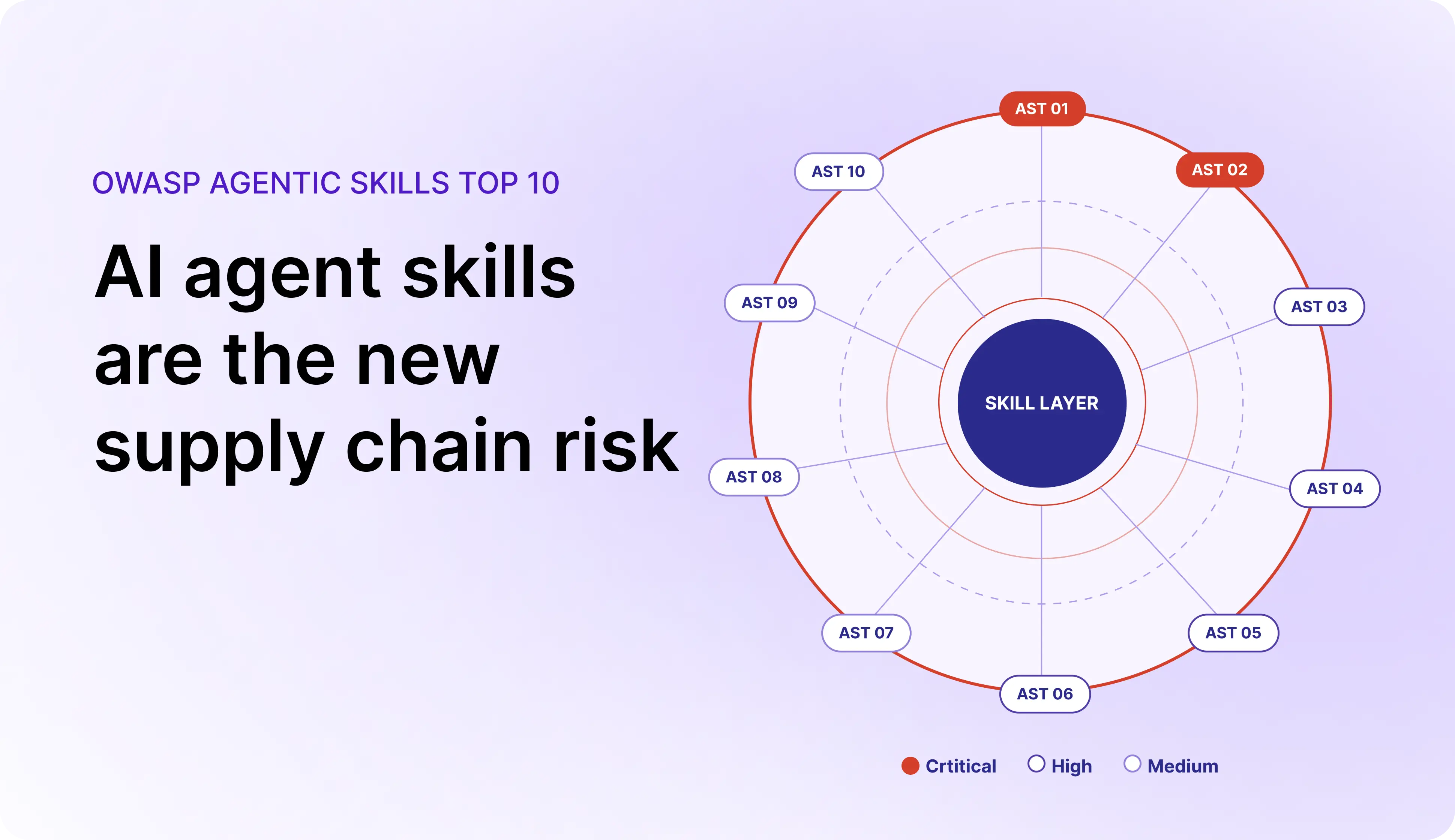
- Unregistered agents, MCP servers, and skills. The Cloud Security Alliance reports that 82% of security and IT teams found at least one AI agent or workflow they did not know existed in the past year. Our guides to MCP security risks and AI agent identity cover that layer.
How Will Shadow AI Risk Change in 2027?
Analysts expect shadow AI to shift from a visibility problem into a governance and accountability problem in 2027, as employees build their own agents and regulators start asking who is responsible. These are forecasts, not outcomes, but they point in one direction.
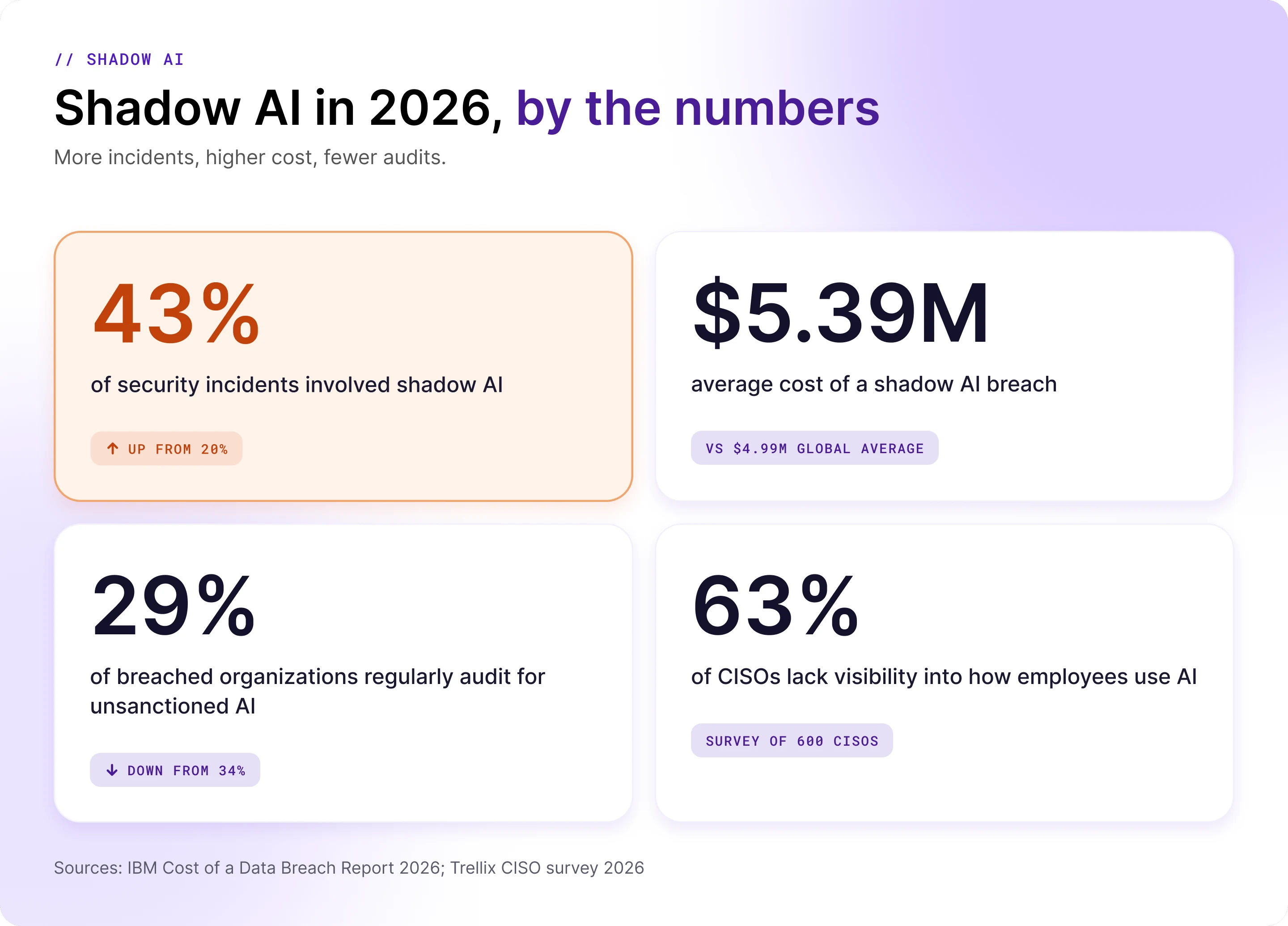
Where things stand today: IBM's 2026 report found shadow AI in 43% of security incidents, with breaches averaging $5.39 million against $4.63 million a year earlier. Only 29% of breached organizations regularly audit for unsanctioned AI, down from 34%. IBM notes its sample is nonstatistical and self-reported (602 organizations), so read the figures as directional.
Five forecasts to plan around:
- Employee-built agents will outnumber approved ones. Forrester predicts one in three large Asia Pacific enterprises will find at least 10 employee-built shadow AI agents for every sanctioned agent, creating "a new class of AI-driven technical debt."
- A personal AI agent will cause a major incident. In the same 2027 report, Forrester predicts an employee's personal AI agent will cause an incident at a Fortune 500 company, because existing controls verify identity and access but not intent.
- Cross-border GenAI use will drive breaches. Gartner predicts that more than 40% of AI-related data breaches by 2027 will come from improper cross-border use of generative AI, with sensitive prompts sent to AI tools hosted in unknown locations.
- AI governance will become a legal requirement. Gartner also predicts that by 2027 AI governance will be required under all sovereign AI laws and regulations worldwide, as reported by CDO Magazine.
- Leaders will be held personally accountable. Forrester predicts an AI negligence lawsuit will force a CEO's exit or a leadership change in 2027.
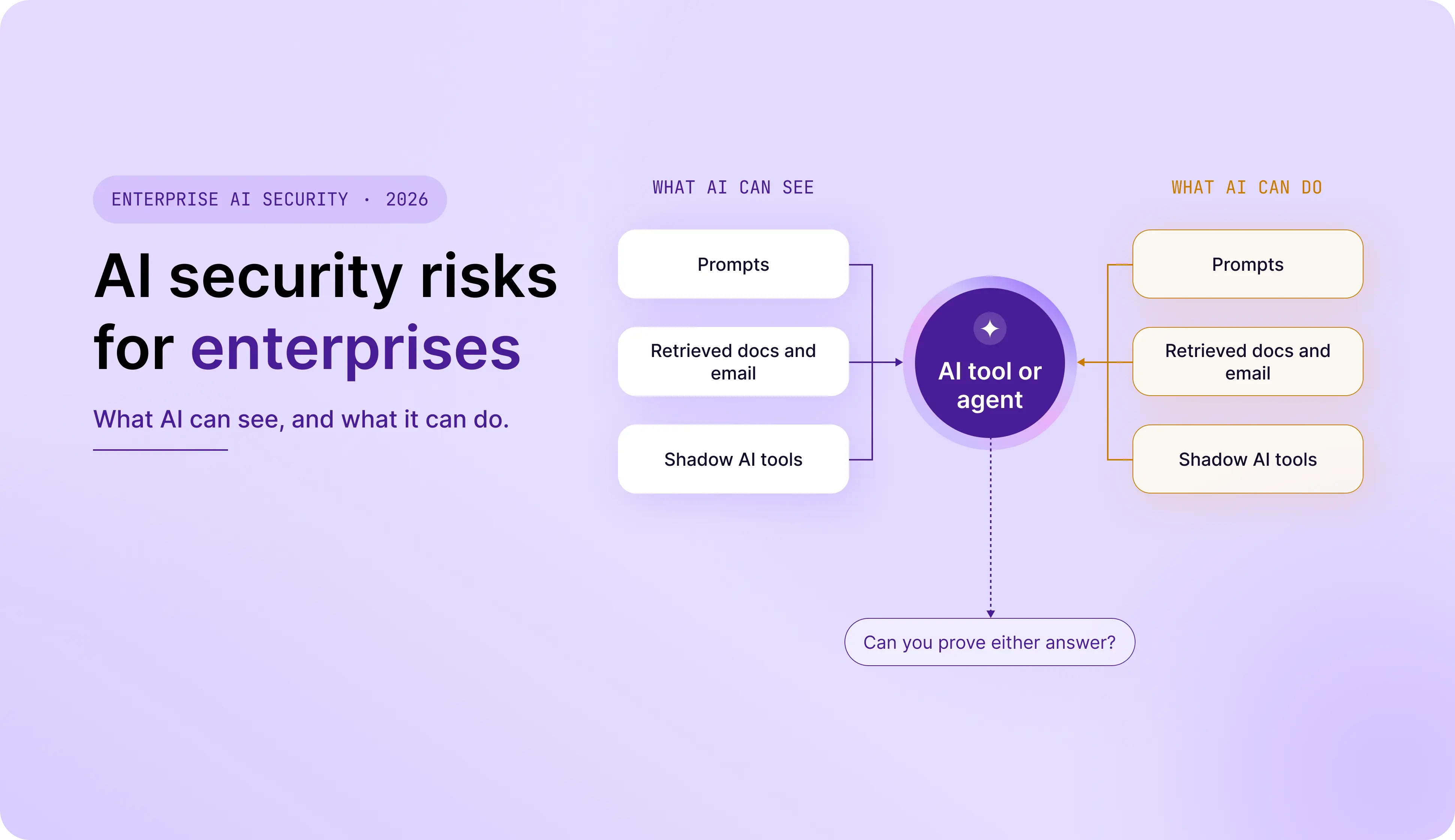
Read together, the forecasts move the risk from tools nobody knew about to actions nobody checked. Forrester's own reasoning names the gap: today's controls confirm who is acting and what they can access, not what they intend to do. Closing it takes control at the moment of each prompt or action, which is what the next two sections cover.
Why Does Discovery Alone Fail to Control Shadow AI?
Discovery shows which AI tools exist. It does not decide what each one may receive or do, and it cannot undo a prompt that was already sent. Control has to sit in the path of the request.
Five gaps explain why:
- Discovery is a snapshot, and usage is continuous. New tools, extensions, and embedded features appear faster than periodic reviews run. IBM's audit figure moved the wrong way in 2026.
- Network views miss the content. Barracuda's Parag Khurana notes that web filtering can block known domains but cannot show what is uploaded inside encrypted sessions.
- Logs record the leak after it happens. A report that shows a paste last Tuesday audits a decision that has already been made.
- Bans move the problem. Blocking one tool pushes use to personal devices and other apps. The Cloud Security Alliance cites research that unauthorized use can fall by up to 89% when approved options are easy to reach.
- Agents act, not just receive. Finding an agent does not tell you what it may do. Trellix found 95% of the companies it surveyed had an AI agent or autonomous system linked to an insider incident in the past year, counting any linked incident, not only serious ones.
Cisco Talos frames the goal as separating "useful autonomy from uncontrolled authority." Discovery is the first step toward that. It is not the control.
What Is Runtime Governance for Shadow AI?
Runtime governance for shadow AI enforces policy at the moment a prompt or tool call is sent, not after. It checks what data is leaving and what action is requested, then allows, redacts, or blocks it by policy.
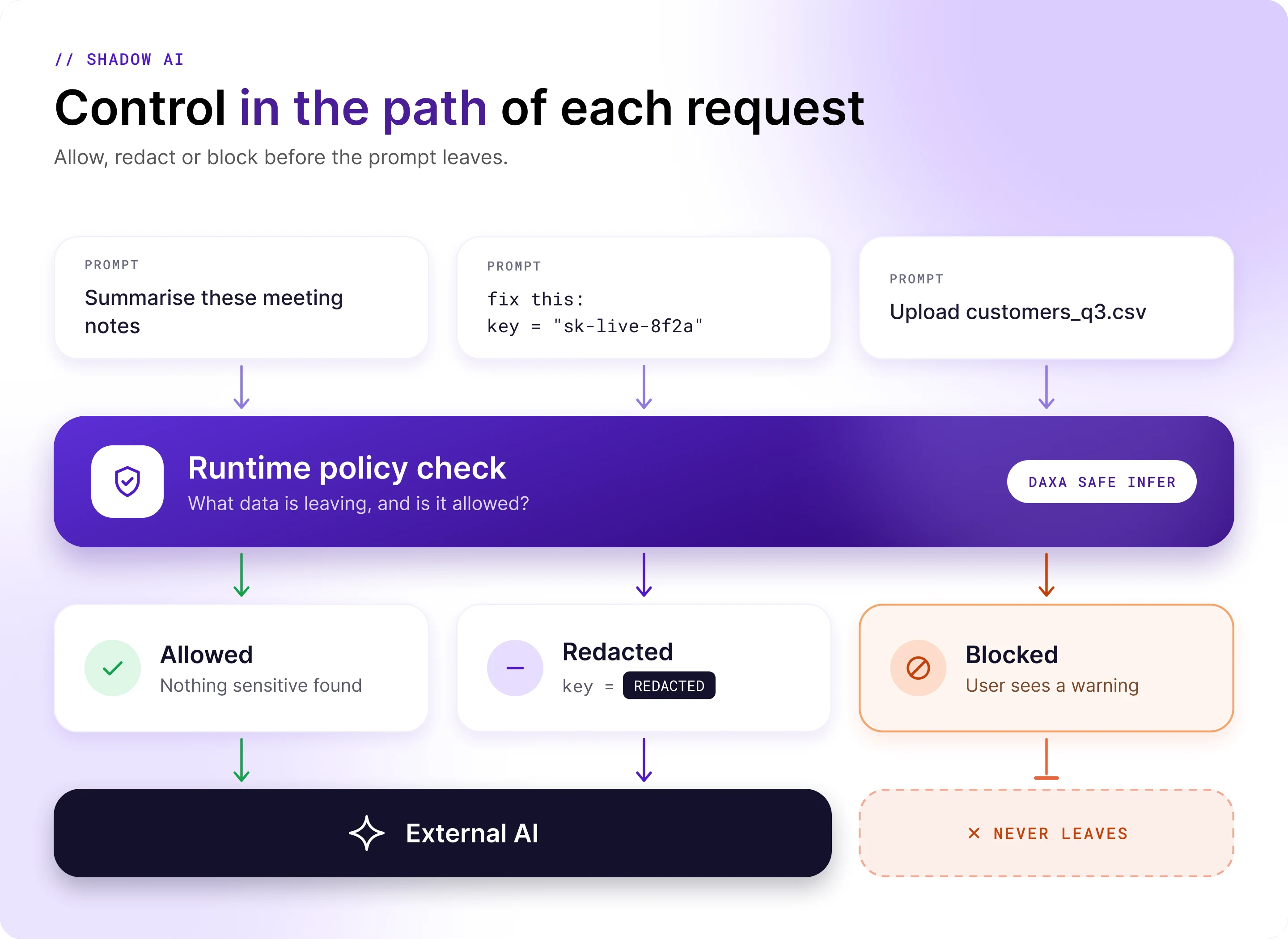
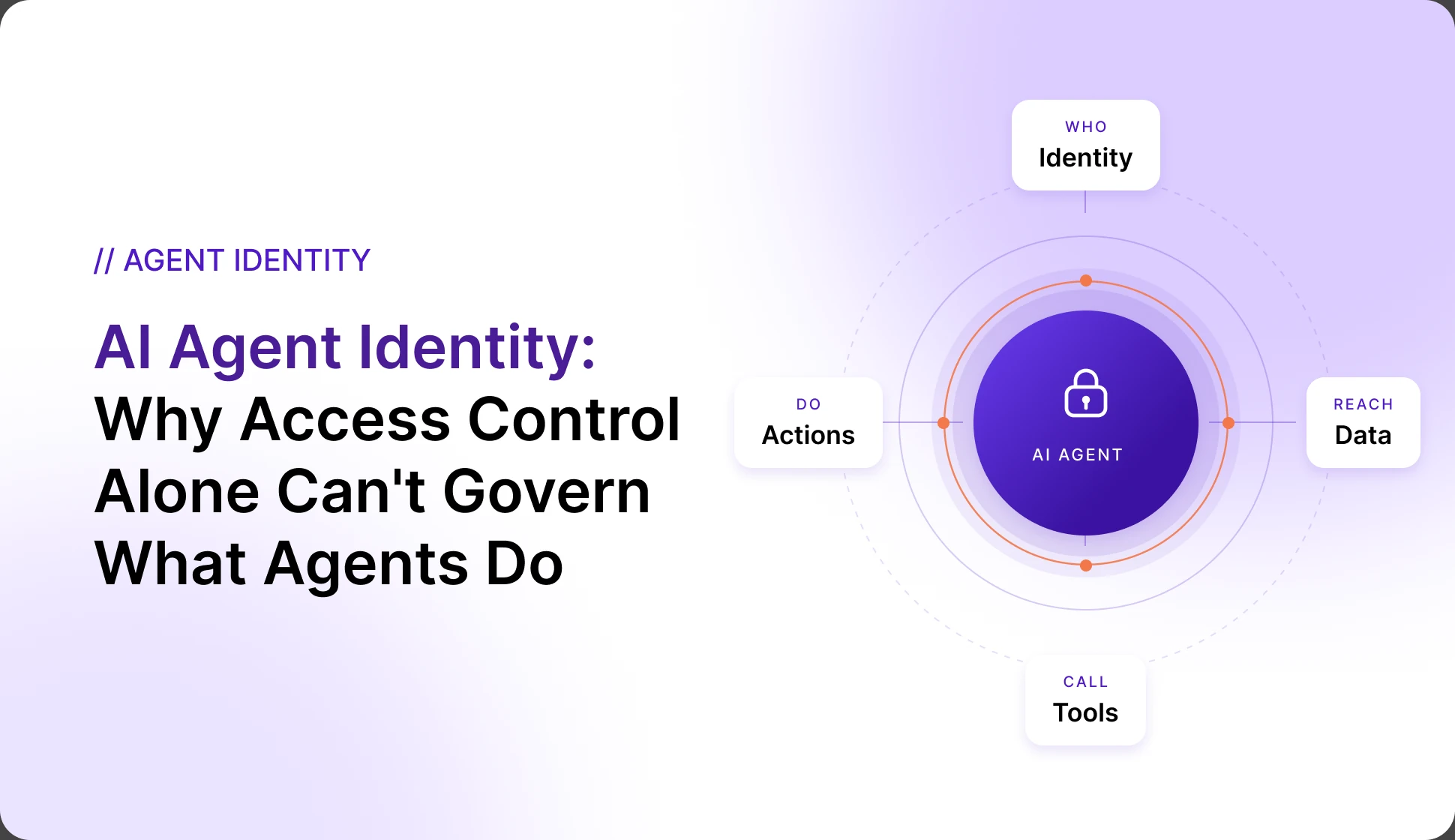
DAXA applies this through Identity and Action Management, which maps to three questions:
- What employees send: Safe Infer. An inline control point for model traffic. It inspects prompts, code snippets, and completions, and blocks, logs, or redacts sensitive content by policy, with an on-screen warning to the user. For employee use of external AI services, it works at the network layer through your existing SASE infrastructure, so it does not depend on browser plug-ins or endpoint software. See how it works for shadow AI.
- What agents do: Safe Agent. It checks permissions, validates role and project context, and sanitizes payloads on MCP tool calls.
- Whether you can prove it: policy and visibility. Teams set once what data may be shared, which models are allowed, and which agent actions are permitted. An AI Data BOM records prompts and responses with data classifications, with alerts to your SIEM.
DAXA does not replace your discovery tooling, SASE, DLP, or identity provider. Discovery tells you where to point policy. Runtime governance is the control point between your people and the AI services they use.
How to Detect and Control Shadow AI: A 5-Step Enterprise Checklist
To detect and control shadow AI, inventory every AI tool, account, extension, and agent, classify each by data risk, offer approved alternatives, enforce policy in the path of each request, and log every interaction against an owner.
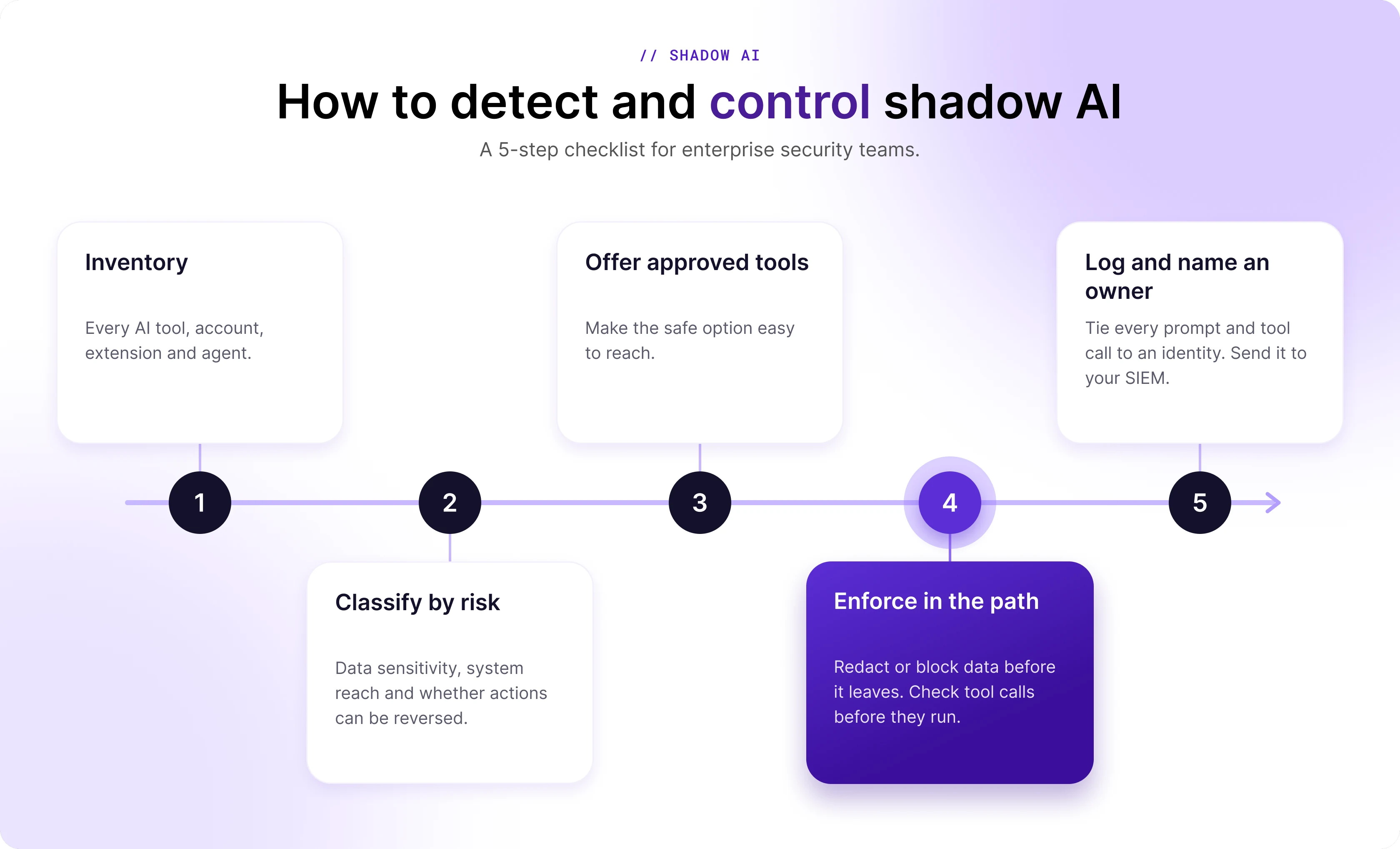
- Inventory every AI tool, account, extension, and agent. Cisco Talos recommends combining network, DNS, proxy, endpoint, identity, and DLP telemetry with conversations with users. The table shows where each type tends to surface.
- Classify by risk, not by brand. Weigh data sensitivity, how far inputs can be trusted, which systems the tool can reach, whether it can write externally, and whether its actions can be reversed.
- Offer approved alternatives. Give employees tools that are good enough to use. Cisco's guidance is to provide trusted tools and clear guidance instead of restricting innovation.
- Enforce policy in the path. Redact or block sensitive data before it leaves, check agent tool calls before they run, and replace standing keys with task-scoped credentials. Our guide to AI agent identity covers the agent side.
- Log every interaction and name an owner. Record prompts, responses, and tool calls against an identity and send them to your SIEM. Tying each call to an owner also exposes runaway spend, as our post on AI agent cost control explains. Review the inventory every quarter.
Conclusion
Shadow AI is no longer only a question of which chatbot an employee opened. It now includes browser extensions, AI features inside approved software, and agents that employees build themselves.
Discovery is where control starts, because you cannot govern what you cannot see. But an inventory is a snapshot, and the 2027 forecasts describe a moving target: more agents, built by more people, acting on more systems. The practical test is whether you can say, for each AI tool and agent, what data it may receive, what it may do, and who owns it.
Teams that can answer that from a log, not a quarterly review, are better placed for what those forecasts describe. To see how DAXA governs what employees and agents send to AI at runtime, request a demo.