


Governance for AI coding assistants like Claude Code, Cursor, GitHub Copilot, Codex, and Replit
DAXA prevents attacks before they happen. One control point governs what your source code, secrets, and IP can send to external models, what actions autonomous agents can take, and what every team spends on AI tokens.



DAXA


















Trusted By Teams At








// See it in action — Claude Code & Codex
Watch DAXA govern AI coding assistants in real time
A live terminal session: a prompt carrying credentials, a policy hit in path, and a redacted completion the developer never has to think about.

//COVERED ASSISTANTS





Every connected assistant in your stack
// How DAXA works
How DAXA governs every AI coding assistant
Coding assistants risk data in two places: at the inference layer, where prompts and completions travel to external models, and at the MCP layer, where agents connect to your data, tools, and systems. DAXA governs both from one policy engine, in path, with no workflow changes for developers. Four controls. Live in minutes.













Inspect what leaves the IDE
Every prompt and completion is scanned in path. Secrets, credentials, and proprietary code are blocked or redacted before they reach an external model. via Safe Infer, at the inference layer
via Safe Infer, at the inference layer
1
2
Scope what agents can do
Every MCP call and tool call is validated against your policies. Agents stay bound to role and project. Unsafe actions never reach your systems, even the hijacked ones trying to exfiltrate context they were never meant to hold.
via Safe Agent, at the MCP layer
Set policy once, prove it everywhere
One policy plane across assistants, repositories, and regions. Full audit trail and real-time alerts to Slack and Splunk. Start in monitor mode. Enforce when you have the data. via Policy Plane
via Policy Plane
3
4
Prove every decision, on demand
Every prompt, retrieval, tool call, and cost event is captured with a tamper-evident audit trail, exportable per application. When an auditor, a regulator, or your board asks for evidence, it becomes a query rather than a project.
via Audit and Evidence
via Audit and Evidence
By 2028, Al coding costs will overtake the average developer's salary.
Dual-layer security for model and retrieval, EchoLeak-class defences, and developer-friendly integration in minutes.

// Built for your team
One platform. Two buyers. Zero friction.
Security leaders get control without slowing shipping. Engineering leaders get faster releases without cost surprises. Both work off the same policy plane, the same audit trail, and the same real-time enforcement.
// For Security Leaders
Security teams get control without slowing shipping.

















Stop leaks at the source
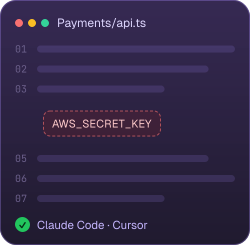
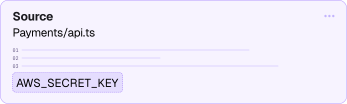
Secrets, source code, and IP are blocked before they reach any external model. Classification runs on the assembled prompt in path, so sensitive context never becomes model context in the first place.
Govern every agent action
Access management extends into action management. Every retrieval, write, delete, and share is adjudicated against your policies in real time, no matter which agent, app, or model is behind the request.
Audit-ready by default
A tamper-evident record of every prompt, completion, and tool call, exportable per application. When an auditor asks for evidence, it becomes a query rather than a project. SOC 2 aligned and HIPAA-ready.
Live threat detection
Prompt injection, over-privileged agents, and out-of-scope writes are caught in path. Alerts fire to Slack and Splunk the moment a policy hits, not next quarter in a report.
// For Engineering Leaders
Engineering teams get faster shipping without cost surprises.
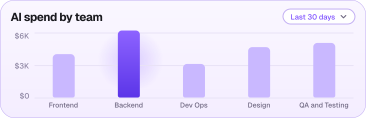


See AI spend by team and by coding agent
Track token usage and cost across Cursor, GitHub Copilot, Claude Code, and every other assistant your teams use. Drill down by team, by project, or by individual agent so you know exactly where the AI bill is coming from.
Set budgets and usage caps
Cap spend per team, per project, or per agent. Prevent runaway coding agents and unbounded loops before they land on the invoice. Governance owns the budget, not whoever shipped the feature.
Route smart, not expensive
Match each request to the right model based on complexity and sensitivity. Reserve frontier models for tasks that need them. Route everything else where it belongs, at a fraction of the cost.
Adoption without a rewrite
Drop in one JSON config per coding agent. Keep your IDE, your framework, and your model choice exactly as they are. Developers keep working the way they already work. Governance is invisible until it matters.






// Threats to AI-assisted coding
Know the threats facing your AI coding assistants
The AI coding assistants your teams already use introduce a category of risk that traditional endpoint, repository, and DLP tools cannot see. Filter by the assistant your team uses to explore the documented exploits, misconfigurations, and behaviors most relevant to your stack.



Showing 4 of 8 threats

Secrets in prompts
.env files, API keys, and credentials sent to external models before code reaches a repo.

Cursor

GitHub Copilot

Claude Code

Codex

Replit Agent
Auto-run destructive commands
Terminal agents execute shell commands with full developer permissions. Documented database deletions in the wild.
Cursor
GitHub Copilot
Claude Code
Codex
Replit Agent
Repository indexing exposure
Semantic indexes leak proprietary logic and cloud tokens outside DLP inspection.
Cursor
GitHub Copilot
Claude Code
Codex
Replit Agent
Injection via README
Malicious instructions hidden in repo artifacts hijack the assistant to exfiltrate .ssh keys.
Cursor
GitHub Copilot
Claude Code
Codex
Replit Agent

Showing 4 of 8 threats
Secrets in prompts
.env files, API keys, and credentials sent to external models before code reaches a repo.
Cursor
GitHub Copilot
Claude Code
Codex
Replit Agent
Auto-run destructive commands
Terminal agents execute shell commands with full developer permissions. Documented database deletions in the wild.
Cursor
GitHub Copilot
Claude Code
Codex
Replit Agent
Repository indexing exposure
Semantic indexes leak proprietary logic and cloud tokens outside DLP inspection.
Cursor
GitHub Copilot
Claude Code
Codex
Replit Agent
Injection via README
Malicious instructions hidden in repo artifacts hijack the assistant to exfiltrate .ssh keys.
Cursor
GitHub Copilot
Claude Code
Codex
Replit Agent
Showing 4 of 6 threats
Rules file poisoning
Poisoned assistant rules survive project forks and travel silently with the codebase.
Cursor
GitHub Copilot
Claude Code
Codex
Replit Agent
Ghost token cache leak
Cached authentication tokens leak between developer sessions on shared runners.
Cursor
GitHub Copilot
Claude Code
Codex
Replit Agent
Showing 4 of 8 threats
Secrets in prompts
.env files, API keys, and credentials sent to external models before code reaches a repo.
Cursor
GitHub Copilot
Claude Code
Codex
Replit Agent
Auto-run destructive commands
Terminal agents execute shell commands with full developer permissions. Documented database deletions in the wild.
Cursor
GitHub Copilot
Claude Code
Codex
Replit Agent
Repository indexing exposure
Semantic indexes leak proprietary logic and cloud tokens outside DLP inspection.
Cursor
GitHub Copilot
Claude Code
Codex
Replit Agent
Injection via README
Malicious instructions hidden in repo artifacts hijack the assistant to exfiltrate .ssh keys.
Cursor
GitHub Copilot
Claude Code
Codex
Replit Agent
Showing 4 of 8 threats
Secrets in prompts
.env files, API keys, and credentials sent to external models before code reaches a repo.
Cursor
GitHub Copilot
Claude Code
Codex
Replit Agent
Auto-run destructive commands
Terminal agents execute shell commands with full developer permissions. Documented database deletions in the wild.
Cursor
GitHub Copilot
Claude Code
Codex
Replit Agent
Repository indexing exposure
Semantic indexes leak proprietary logic and cloud tokens outside DLP inspection.
Cursor
GitHub Copilot
Claude Code
Codex
Replit Agent
Injection via README
Malicious instructions hidden in repo artifacts hijack the assistant to exfiltrate .ssh keys.
Cursor
GitHub Copilot
Claude Code
Codex
Replit Agent
Showing 4 of 8 threats
Rules file poisoning
Poisoned assistant rules survive project forks and travel silently with the codebase.
Cursor
GitHub Copilot
Claude Code
Codex
Replit Agent
Cross-project data bleed
Agent contexts spill data across project boundaries when session isolation is weak.
Cursor
Claude Code
Codex
Replit Agent
Plaintext config credentials
Local assistant configs store tokens in plaintext, ingested into the model context window.
Cursor
Claude Code
Codex
Replit Agent
Ghost token cache leak
Cached authentication tokens leak between developer sessions on shared runners.
Cursor
GitHub Copilot
Claude Code
Codex
Replit Agent


// Trusted Voices
Smart takes on AI, data
and security


Zero Trust and AI Firewalls can’t protect Enterprise AI without reasoning over data. DAXA saw that very early on.
Claudio Coelho Jr
Fmr Head of AI at Palo Alto & ZScaler


DAXA stands out because they refuse to take short cuts on the deep engineering challenges of AI security. They tackled the hard work of context and authorization at the root. They didn’t build the easy solution, they built the right one.
Sam Chehab
CISO Postman

Company data, whether internal or customer data, ingested into Gen AI apps is at increasing risk of unauthorised access, harmful leaks, and privacy violations. Pebblo's developer friendly controls help our teams rapidly build secure by default Al apps that protect data with just a few lines of code. This ensures that we have the right data inputted and outputted to the authorised parties, strengthening our defence in depth.
Ryan Tolentino
Global Head of Multi cloud security, SAP

Every AI application relies on corporate data to ground LLMs in enterprise truth. A key data security challenge for developers is controlling who has access to what. By restoring enterprise data lineage covering its source, entitlements, and semantics DAXA introduces the first developer-centric approach to solving data access governance issues in AI apps
Nico Popp
Former Chief Product Officer, Tenable & ForcePoint

Without governance, you're one vibe-driven hallucination away from a galactic-scale outage. Pebblo MCP Gateway is the missing command structure that turns chaotic agents into a disciplined force you can trust in production
Mark Dorsi
CISO, Netlify
Security and cost control for every AI coding assistant in your stack
Book a demo. Live in days. Start in monitor mode on two applications. At the end you have a report on your own traffic, and the argument is over.
How does DAXA secure AI coding assistants like Claude Code, Cursor, GitHub Copilot, Codex, and Replit?
DAXA sits in path between the developer's IDE and the external model. Every prompt is scanned for secrets, source code, and IP before it leaves. Every tool call an agent makes is validated against your policy. One control plane covers every assistant your teams use, with no changes to how developers work.
Where does DAXA run, and does our data ever leave our environment?
DAXA deploys inside your environment. VPC, on-premises, multi-cloud, or fully air-gapped, whichever fits your architecture. No prompts, no code, no metadata ever leaves your perimeter. Your data stays where your data lives, governed by policies you own.
How long does it take developers to onboard, and does it change their workflow?
Developers onboard in about two minutes using our setup scripts. Drop in one JSON config per coding agent, keep your IDE, your framework, and your model choice exactly as they are. Streaming responses stay streaming. Governance runs in path alongside a call that already takes hundreds of milliseconds, so developers do not feel it until a policy fires.
How do you track and control AI token spend across teams and coding tools?
DAXA gives you consumption visibility by team, by project, and by individual coding agent. Set budgets and usage caps. Route requests to the right model based on complexity and sensitivity. See exactly where your AI bill is coming from, with the same audit trail you get for data access.
How is DAXA different from large cybersecurity vendors moving into AI security?
Most cybersecurity platforms treat AI as another surface to secure. DAXA governs the data itself. Sensitive context never becomes model context in the first place, agent actions are adjudicated before they touch your systems, and every prompt, retrieval, and write carries a lineage. That is why enterprises like HPE, Postman, Netlify, and SAP trust DAXA to sit between their teams and the models.


